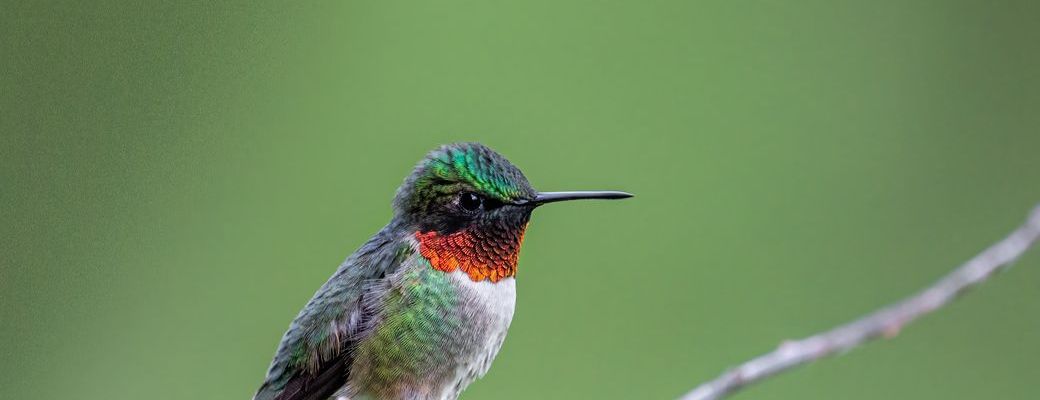
A few years ago I bought a hummingbird feeder, the kind with the upside down jar on a bright red plastic base. I had big hopes for a backyard full of the tiny, fleeting creatures, that when I looked out the kitchen window I’d see a shimmer of emerald and ruby as hummingbirds hovered nearby.
I used that feeder only once because my kids were afraid of the many, many bees it attracted. But I still had dreams of hummingbirds. So last year I found a hanging basket that overflowed with a scandalous amount of red blooms. At least two garden store employees assured me it would absolutely attract hummingbirds. But I never once saw one visit that whole season.
I’ve had to be content watching the hummingbirds elsewhere. Like in my sister’s yard, where so many zoom around I get dizzy watching them. Or at my cabin-neighbor’s house where you can see them perch in the trees nearby. Or that one coffee shop patio that, despite its partially being in the parking lot, must have the right kind of flowers in its planters. I’ve even seen hummingbirds darting around the trash can at our neighborhood park, an ultimate blow to my backyard.
It’s mid-September and I can hear the Ruby-thoated hummingbirds chirping all around the neighborhood. They’re the only kind of hummingbird that lives in the state where I live, Minnesota. As summer slips into fall, they become frantic with the need to eat as many calories as they can find before migrating to the southern shores of the Gulf of Mexico. Many of the dainty birds fly all 500 miles across the Gulf without once stopping for food or water.
For their epic migration hummingbirds fiercely defend their food sources, which is why one can hear their territorial chirping on late summer days. Hummingbirds get most of their flying power from flower nectar, especially jewelweed which blooms just in time for the birds’ migration. They also eat small insects when they can, for protein and minerals, but everything about their miniscule bodies is fine tuned to sip from delicate flowers. At its chosen bloom a hummingbird will hover, in just one second, beat its wings in 70 figure-eight patterns, while its tongue laps nectar 13 times per second.
A hummingbird’s miniature, full-speed existence is precarious. If they cannot eat enough, they will not live. Whenever the temperature dips too low, they have to enter a state or torpor to survive. If they are forced to rest in torpor, they become easy snacks for frogs, other birds, spiders, and even dragonflies. The seasons chase them into long migrations, forcing the birds to leave when their food withers and temperatures drop. Staying a day too long or embarking without enough calories often ends tragically.
Time, for hummingbirds, is always fleeting. It is for us too, and I feel it especially in September.
The minutes of sunlight decrease each day. The nighttime cricket-songs fade more each evening. The fireweed is done blooming and the maples down the block are starting to turn. The birds are quiet in the mornings now, especially compared to the memory of spring’s dawn chorus.
The kids have started a new year of school and they’re somehow one year older. It shouldn’t be surprising, I know how time works. But September forces me to see life in a series of school pictures: my kids once seemed so old in last year’s pictures, the same photos that will soon reveal softer cheeks and younger eyes when this year’s batch come home.
Everything is fleeting in September. Fleeting, like the hummingbirds who are noisy and zipping around today, and tomorrow will suddenly all be gone.
The kids are growing up- all of them- and as the leaves start falling to the ground and the birds begin to disappear south, I can, even now, feel my heart squeeze. I don’t want to stop it all but I do want to hold it- my kids, the light of summer, the blazing maple leaves, all of it- just a little bit longer.
Yesterday I was reading a book in the backyard when, out of the corner of my eye, I saw a hummingbird. In my backyard! It was checking out a misfit begonia I had purchased back in May only because my son had fallen in love with it. Despite my neglect, the begonia refused to die. Its leaves were yellowing, some had been brown and crispy for over a month, but the rest held tight to life and its little red flowers danced in the breeze.
When the hummingbird showed up I froze, going so far as to hold my breath. It zipped behind me for a moment and I didn’t even turn to follow it. Lucky for me, the bird came back to the begonia for one last sip. I have no idea if it was male or female because it was all too fast for me to see its colors. But it was lovely, this little shimmering flame of a bird. It stayed for less than a minute before flying off for good.
And I remained, wishing that I could have just held onto that fleeting moment- like so many in September- for just a tiny bit longer.


Thank you Sarah! Beautiful! The hummingbirds left Ely about two and a half weeks ago. We have two feeders on the deck at the cabin and I so love sitting to listen and watch them! Sending you peace and love. Barb Tjader
LikeLike
“I don’t want to stop it all but I do want to hold it”
I needed this. Thank you.
LikeLike
Oh, how I love your writing!! Thanks for sharing this!!
LikeLike