My son loves to decorate the yard for Halloween every year. The more skeletons, spiders, and inflatable monsters he can play with, the better. So on a quest at the store last week to procure ‘just one more skeleton,’ I was delighted to see some creepy bird decorations. Our options were mostly ravens and crows, even one in skeleton form (which we absolutely bought) and it all got me wondering; of all the birds, which is creepiest?
Despite Edgar Allen Poe’s great work, I don’t think ravens are scary. They’re just unnervingly smart. Same for their birdy cousins, the crows. Bald and looming vultures are Halloween-y with their well earned gross-factor (defensive projectile vomiting!?!), but in actuality they’re just world class recyclers. Recycling is decidedly not creepy.
You might have a favorite creepy bird; ‘creepy’ being based on their appearance (have you seen a shoebill stork?), their sound (barn owls), or their behavior (the infamously dangerous southern cassowary). But do you know what’s really frightening? I mean, bone-chilling, wake-up-in-the-middle-of-the-night-feeling-dread scary?
Not existing. At all. Being alive one moment, and not alive the next.
And how about not only un-alive, but extinct, with nobody related to you or even like you to ever live again. Dodos are extinct which really ought to freak us out on a meta-level. Even more ghastly, the tiny details we think we know of this extinct bird are wrong. Dodo birds are completely lost to the world and to our memories. Happy Halloween, everyone.
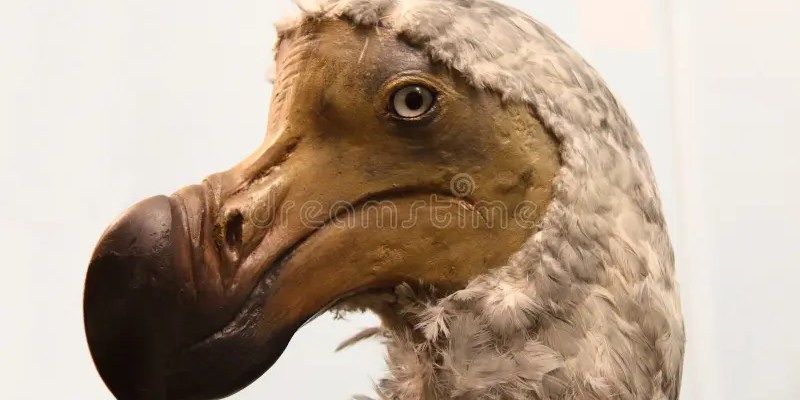
When I say “dodo” an image of a bird probably pops up in your mind and it’s the same image that pops up in everyone’s mind. It’s of a drab gray bird with a bald face, a bizarre beak, and a body that is a cross between a turkey (in that it’s a large, grounddwelling bird) and a poodle (in that it looks too proper to be real, with its odd bustle of a tail and dainty little wings).
That image comes directly from a painting made by a Dutch artist, Roelant Savery. Savery was known for painting the first Dutch floral still-lifes and city scenes. But his most famous work, by far, is The Dodo and Other Birds (1630).
Unfortunately for all of us, but especially for dodo birds, Savery never once saw a dodo with his own eyes. He based his painting on reports from a few sailors who had visited the island of Mauritius (the only home of dodos) in 1598.
Savery’s painting lives in the Natural History Museum in London, right next to an old 3D model of a dodo. The model was made in Victorian times by a well-known taxidermist, James Rowland Ward, who based his model from Savery’s painting. Meaning, Ward also never saw a real dodo! Our only image of the dodo is nothing more than a visual game of ‘Telephone.’
Nature writer Stephen Moss, in his book Ten Birds that Changed the World, recalls his first encounter with the dodo model in London’s famous museum. He says,
“Everything I could see was artificial. The head, beak and other bare parts had been moulded from plaster; the feathers were from swans and geese, dyed to produce the unappealing dirty grey colour. The Irish writer Roisin Kiberd perfectly sums up its rather dubious status: ‘It’s a composite, a Franken-dodo made out of parts of other birds sewn together in the image of something never seen in real life by its creator.’
Speaking of monsters, we’ve heard that dodos went extinct because they were too stupid to run from hungry sailors. Also, untrue. The real reason why dodos went extinct is much scarier.
It seems that, when Dutch sailors first encountered Mauritius in 1598 (the island is 1200 miles east of Madagascar), humans had not lived on the island in any significant way for a very, very long time. Completely protected from predators, dodos lost the ability to fly (since it was unnecessary in such a safe space). When Europeans started bringing to the island their domesticated animals (pigs), stowaways (rats), and exotic pets (monkeys), dodos- and particularly their hatchlings that lived in nests on the ground- didn’t stand a chance against these new, hungry and diseased predators.
How many times have we heard this same story in other lands and to the demise of other creatures? The idea of hungry sailors clubbing the last dodo for dinner is an idea fit for Hollywood. But the real reason dodos are now extinct, the irresponsible and reckless actions of humans, is much more chilling. And familiar.
The death of the last dodo probably happened around 1662, less than 100 years after we first encountered them. Moss writes that that final dodo death ushered in The Age of Extinction, “In the 300 years or so since it died out, we have lost hundreds more species.”
The great auk in 1844. Passenger pigeons in 1914. The ivory-billed woodpecker in 1944. The Kaua’i ‘akialoas in 2016. And most recently, the Hawaiian ʻŌʻū in 2024. This Halloween, one in seven of the world’s bird species is at risk.
A group of dodos has been called both a ‘waddle’ and an ‘extinction.’ In honor of the month of October and in recognition of humanity’s fearful treatment of so many creatures, I’d like to propose we refer to a group of dodos as a ‘haunting.’ For this one, we deserve to be a little scared.

